Showing posts with label Nanjing. Show all posts

Tuesday, May 12, 2009

Once More, Nanjing

Here is a last set of photos from Nanjing. This is at the old southern wall and gate. I'd look up the name of it again, but I don't feel like it.


The gatehouse from the interior side (facing the inside of the city, although, of course, the modern city stretches far beyond the walls). On the right, you can see the concentric layers of gates.


On the right, a courtyard view of one of the layers in the gate. On the right, John on the main steps up to the parapet wall on the west side.


A model of what the gate would have looked like in its heyday. Note the large building on the top of the wall. It is no longer there. What has replaced it?


A car advertisement! Kind of disappointing.


John, doing whatever it is that John does.

Saturday, May 9, 2009

The Nanjing Massacre Memorial and Museum

This post is all from an outing I took with John about a month and a half ago to Nanjing. It was a different trip from the one shown in an earlier post. Lee and the girls were up to something or other for the day (I can't remember what), so we did a little father and son outing.

John has a book of World War Two sites that can be seen in Asia and the Pacific. Nanjing is the only one on the list that is in easy range of us. The big thing to see there is the Nanjing Massacre Memorial and Museum, and that is where we went.

Upwards of a quarter of a million Chinese in the Nanjing area were killed by the invading Japanese during the war. It is a very sore subject for the Chinese, not only for the horror itself, but for the continuing Japanese tendency to ignore and dismiss wartime atrocities (huge protests broke out a few years ago simply because yet another round of Japanese school textbooks were adopted that whitewashed the whole affair).

I don't have an organized story to go with this, so I will just drop comments as I go. Outside of the museum is a line of rather abstract statues. They have something of the effect, perhaps, of Picasso's Guernica. Each one has a caption that is worth reading, you should be able to read them if you click on them. They kind of capture the general tone of the place, which could just as well be called the "Nanjing Anti-Japanese Memorial". Throughout the memorial and museum, the sense of rage and despair are very palpable.


Past this line of statues (there are several more beyond these four), is the entry to the museum and memorial. At the gate, each guest is asked to write their nationality on a list. I've never had anywhere else ask us to do that. One could assume that this was just for statistical purposes, but I did look through the list quickly and I noted that there were no Japanese on it. Then again, if I were Japanese and coming here, I would sign as a Korean.

The grounds are quite dramatic, and make very good use of space to seem otherworldly.


Here a few pictures of photos and displays within the museum.
The Japanese entry into the city of Nanjing.


The Japanese entry into Suzhou, including a Japanese flag signed by soldiers to commemorate the day.


A torture device, a gibbet of sorts, in which the victim was tumbled. If you look closely, you will see that there are spikes lining the inside. There were actually far more gruesome implements and images, but some of the areas had guards standing by, and the Chinese prohibition of photography is always completely arbitrary. I didn't want to antagonize anyone.

Human remains in an excavation. This is in a different area than the pair that follows.

The centerpiece of the museum is a large excavated area of victims that have been left in situ, and the building has been built around them. It was quite a moving exhibit, even allowing for the distracting horror movie style music playing softly through the PA system.
A very interesting incident occurred for us here. A Chinese woman (probably around age 50), seemed to shadow John for part of the walk. When he stopped part way through, she stepped up to him and said, in English, "Do you believe it is real?!", in a tone that seemed to suggest that he must go forth and bear witness of what he saw there.

As I said, this place brings out real passions for the Chinese.

Thursday, March 19, 2009

Nanjing

I was feeling like I didn't have any interesting pictures to show, but I had forgotten that I had a whole bunch of photos still stored in my camera. I'll get at least a couple of good posts out of them, so I will start out with a daytrip that we took to Nanjing back in the first week of February.

There are two major cities that have, in turns, been the great capitals of China. Nanjing is one, and Beijing is the other. The names are simple, as "Nan" means south, and "Bei" means north. Beijing was the capital during the reign of the Manchus (originally from north of the Great Wall), but Nanjing was the capital up until the success of the Communist Revolution in 1949, when Mao and the gang relocated the capital back to Beijing. For that reason, the Taiwanese often continue to refer to it as the "true" capital of China.

As the capital of China, this city was singled out by the Japanese for especially brutal treatment. There is a major monument and museum to the "Rape of Nanjing", but we didn't go there this trip. We will do that later. In fact, I'm considering going with just John this Saturday, while Lee goes to Shanghai to do some shopping. One of the bargains we made with John to get him to accept this whole China project was that we would take him to see interesting World War II sites, and Nanjing is the closest place to us where there is really something to see. Once we quit worrying about the economy so much, I may eventually take him on a father-son outing to the Philippines. You can get there quite cheaply from here, and there are said to be really good tours of the Bataan Peninsula and Corregidor.

I have another motivation to go to Nanjing again soon... it has a very ominous nickname: "The Furnace of China." That sounds like a good reason not to wait for summer.


The grounds of the Nanjing Museum. In the background you can see the slope of Purple Mountain, a site of great cultural importance to the Chinese. Pearl Buck, the American writer of The Good Earth, grew up in sight of this peak, and wrote lovingly of it. I didn't even try for a good picture of the mountain, as it was overcast that day. I'll post pictures another time if I get good ones.


Some funky sculptures on the grounds of the museum


A mixture of clothes and meat hanging out together to dry.
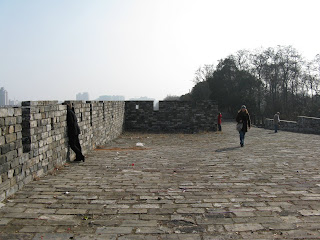

A spot on the city wall. About half of Nanjing's original city walls are intact, more than any other city, I've been told. In the scene are Allyne, Emma, Lee, and Lee's mother Janet, who was visiting us. Once again, a word to you all: visitors are very welcome.
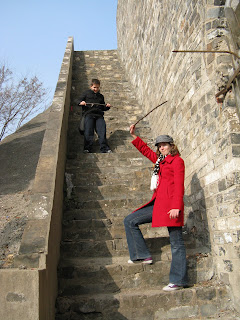


Emma and John on the city wall. On the right, John is standing in an embrasure over the highway facing east. It was from that direction that the Japanese marched through the gate below him and into the city during World War II.

There is one final photo of the Nanjing outing, but Lee has it on her blog. It is very much worth a look.